Eco Homes in London: A Guide to Sustainable House Extensions

🔑 Key Takeaway
Building a sustainable extension is one of the most effective ways for London homeowners to create modern eco homes, enhancing property value while reducing long-term energy costs.
- Sustainable extensions focus on high-performance insulation, eco-friendly materials, and energy-efficient design.
- The return on investment may be realised through lower utility bills and increased property value, with studies showing over 59% of costs can be recouped.
- Government grants and schemes are available in the UK to help offset the initial costs of green home improvements.
Read on for our complete guide to building your sustainable London extension.
Many London homeowners are now transforming their properties into modern eco homes by building sustainable extensions that prioritise energy efficiency and environmental responsibility. This approach not only contributes to a healthier planet but also can offer tangible benefits like lower energy bills, improved living comfort, and a potential increase in property value. This guide explores the key principles, materials, costs, and benefits of creating a sustainable house extension in London.
Drawing on over 30 years of experience renovating London properties, we’ll share expert insights on how to apply these green principles to your home. We will cover everything from sustainable house extension ideas to navigating planning permission for your green home renovation London. Let’s begin by defining what truly makes a house extension “eco-friendly.”
ℹ️ Transparency: This article explores sustainable building practices based on industry research and our direct experience. Our goal is to inform you accurately to help you make the best decisions for your home. All information is reviewed by our in-house expert, Jozeph.
What Makes an Extension Eco-Friendly?
Core Principles of Green Building
An eco-friendly extension is designed and constructed to minimise its environmental impact through energy efficiency, sustainable materials, and reduced waste. A key concept is the “fabric-first” approach, which focuses on maximising the performance of the building envelope (walls, roof, floor, and windows) before considering renewable technologies. Key elements of this approach often include high-performance insulation to prevent heat loss, achieving a high degree of air tightness to prevent uncontrolled drafts, and sourcing sustainable materials that are reclaimed, recycled, or have low embodied carbon. For instance, a 2024 simulation study from the University of West London found that sheep’s wool insulation offers thermal performance comparable to mineral wool but with a significantly lower embodied carbon footprint.
Beyond Materials: Water, Waste, and Energy
True sustainability also considers resource management, including water conservation, waste reduction, and renewable energy integration. For water management, features like rainwater harvesting systems and sustainable drainage systems (SuDS) can play a valuable role in reducing mains water consumption and managing surface runoff. Regarding waste, careful planning and sourcing materials locally can help minimise the environmental impact of construction. Furthermore, a 2022 report from the UK Green Building Council highlights that reusing or repurposing materials like steel can achieve up to a 95% carbon saving compared to using new steel. Finally, integrating renewable technologies, such as solar panels and heat pumps, can further reduce a home’s reliance on fossil fuels.
Sustainable Extension Ideas for London Properties
The Modern Kitchen Extension: Light and Efficiency
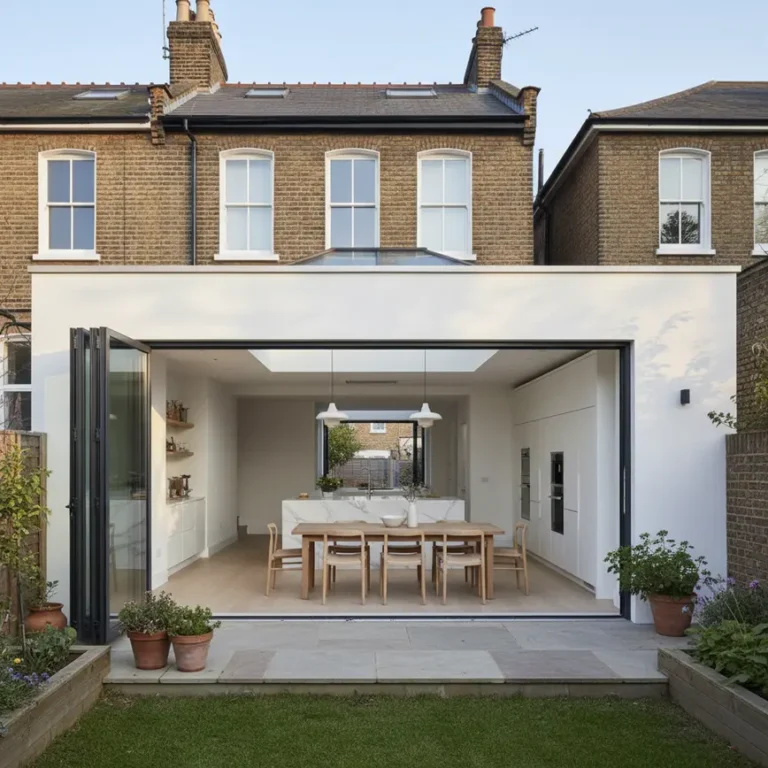
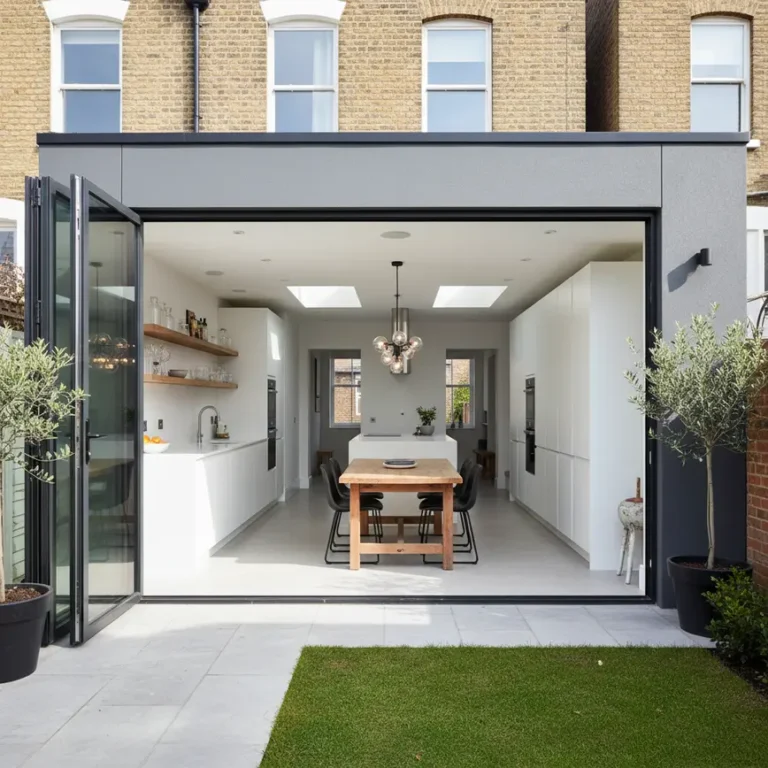
A modern kitchen extension can become a showcase of sustainability by incorporating biophilic design and energy-efficient glazing. Biophilic design involves integrating natural light, ventilation, and views of greenery, which can improve wellbeing. A 2024 systematic review in Frontiers in Built Environment covering 32 studies found that biophilic design in homes consistently contributes to occupant wellbeing, with positive effects on stress reduction and mood. This can be complemented by using eco-friendly glazing, such as double or triple-glazed windows with low-emissivity coatings, to minimise heat loss. Material choices like bamboo flooring, recycled glass countertops, and low-VOC paints further enhance the extension’s green credentials.
Terraced House Solutions: Maximising Space Sustainably
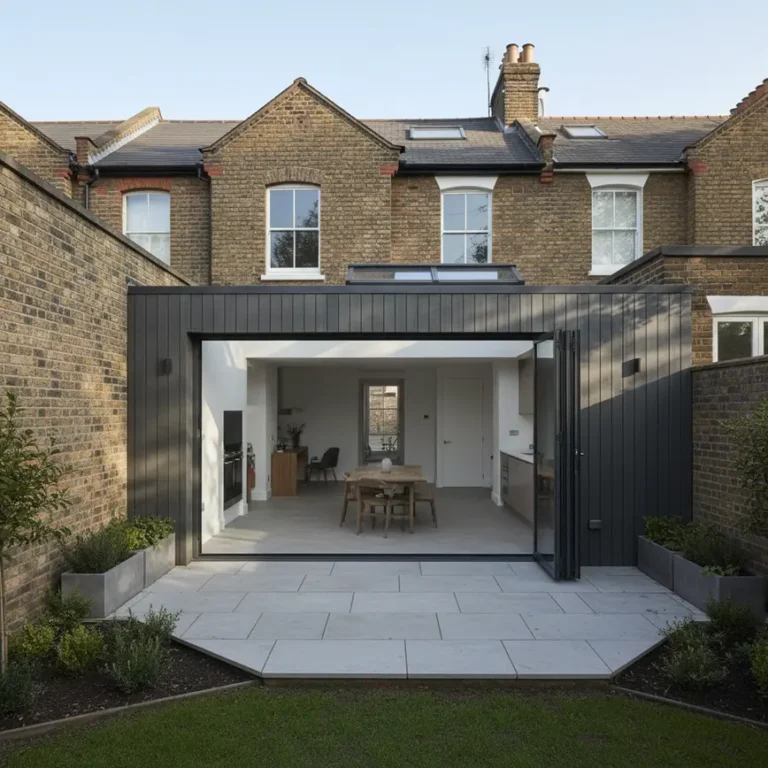
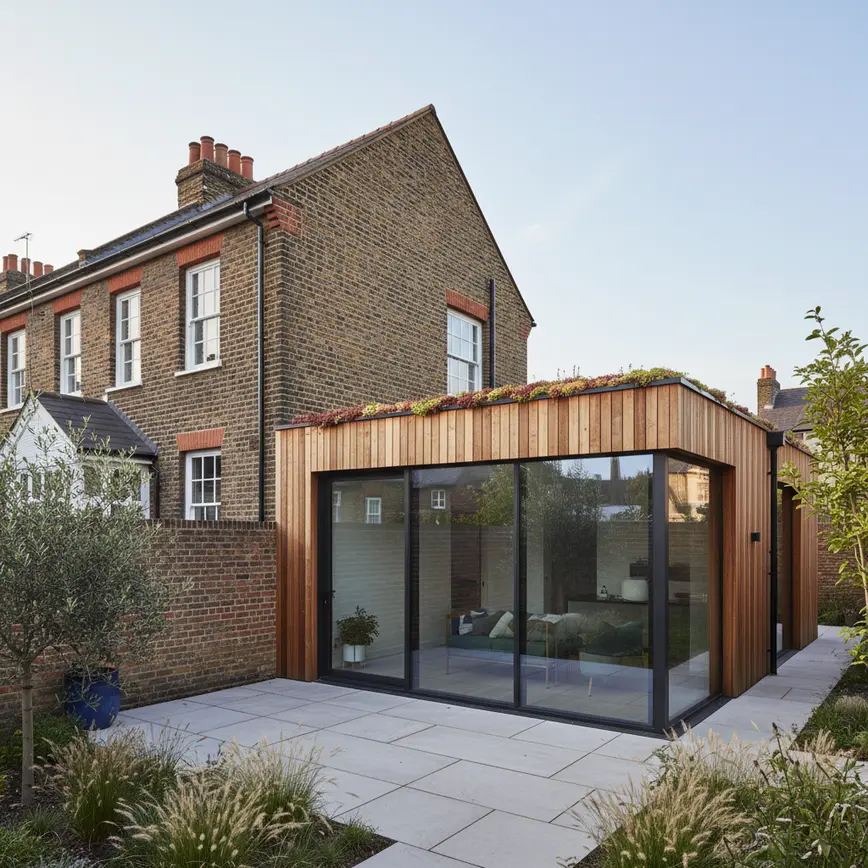
For London’s common terraced houses, a sustainable rear extension can be designed to overcome space and light limitations while improving energy performance. Green roofs are an effective feature; they can improve insulation, manage rainwater effectively, and enhance local biodiversity. Another powerful technique is passive solar design, which involves orienting glazing to capture sunlight for natural heating and light, thereby reducing energy demand. Additionally, timber frame extensions are a popular choice due to their sustainability benefits. They are often quicker to construct, come from a renewable source, and their structure allows for high levels of insulation to be easily incorporated.
The Real Cost and ROI of Building Green in London
Upfront Costs vs. Long-Term Savings
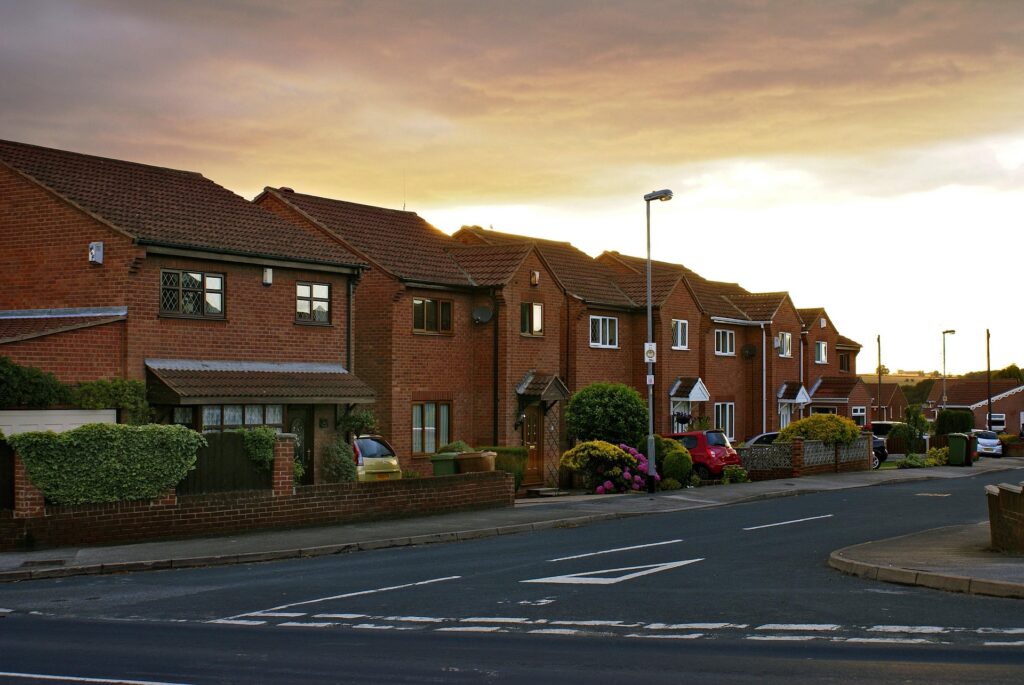
While some sustainable materials can have a higher initial cost, building one of London’s green eco homes may generate significant long-term savings through reduced energy bills. The “payback period” for these eco-upgrades is often shorter than homeowners might expect, especially as energy prices fluctuate. For example, high-performance natural insulation may cost more upfront than standard synthetic options, but its potential to reduce heating costs year after year can make it a sound investment. Furthermore, government incentives can help lower these initial costs. According to official GOV.UK information, schemes like the “Warm Homes: Local Grant” may offer eligible households substantial funds for energy improvements.
| Upgrade | Typical Cost | Potential Annual Energy Saving | Potential Property Value Uplift |
|---|---|---|---|
| High-Performance Insulation | £1,500 – £4,000 | £200 – £500 | Contributes significantly |
| Triple-Glazed Windows | £5,000 – £12,000 | £150 – £400 | Moderate to significant |
| Solar Panels (4kW system) | £7,000 – £10,000 | £400 – £600+ | Moderate |
| Air Source Heat Pump | £8,000 – £15,000 | £300 – £700 (vs. old boiler) | Moderate to significant |
Note: Costs and savings are estimates and can vary based on property size, location, and specific products. Property value uplift is influenced by market conditions.
How a Green Extension Increases Property Value
Investing in an energy-efficient extension can directly increase your property’s market value, as prospective buyers are often willing to pay a premium for homes with lower running costs. Research into the capitalization rates of energy efficiency improvements has shown this trend. For example, a comprehensive study by the Economic Statistics Centre of Excellence (ESCoE) covering 2014–2022 found that, on average, 59.4% of the costs for EPC-recommended energy efficiency improvements are capitalized in the property prices of semi-detached and terraced houses. Improving a home’s Energy Performance Certificate (EPC) rating from D to C, for instance, can add thousands to its value.
Navigating Planning and Regulations for Eco-Builds
Permitted Development for Sustainable Projects
Many sustainable extensions, such as those on extensions on terraced houses, fall under Permitted Development rights, which means a full planning application may not be needed. However, specific features like green roofs or solar panels can have conditions attached, particularly concerning height or visual impact. Key factors that determine whether a project is permitted include its size, location on the property, and overall height. It is always advisable to check with your local council, especially for properties located in conservation areas, where rules are typically stricter to preserve the area’s character.
Working with Local Councils in South London & Croydon
Local councils across London, including Croydon and other South London boroughs, have specific guidance on building regulations for insulation, drainage, and materials. Compliance with Part L (Conservation of fuel and power) of the Building Regulations is mandatory. The 2021 edition of Approved Document L (incorporating 2023 amendments) sets the maximum mandatory air permeability rate for new dwellings and extensions at 8 m³/(h·m²) at 50 Pa, ensuring a high standard of air tightness. Additionally, many councils now require a plan for Sustainable Drainage Systems (SuDS) to manage surface water runoff on-site, a requirement detailed in industry guides like the CIRIA SuDS Manual.
FAQ – Your Sustainable Building Questions Answered
Is an eco-friendly extension more expensive?
Yes, an eco-friendly extension can have a 5-10% higher upfront cost due to premium materials like high-performance insulation and triple-glazed windows. However, this initial investment is often offset by long-term savings on energy bills and potential government grants. Research also indicates that energy efficiency improvements can significantly increase property value, providing a strong potential return on investment.
How can I make my Victorian home more eco-friendly?
You can make a Victorian home more eco-friendly by focusing on insulation, airtightness, and efficient systems. Key upgrades may include installing internal or external wall insulation, replacing single-glazed sash windows with high-performance alternatives, and improving roof and floor insulation. Adding modern, efficient heating systems and smart controls could also dramatically reduce energy consumption while preserving the home’s character.
What are the best eco-friendly materials for a London climate?
The most suitable eco-friendly materials for London’s damp, temperate climate are often those with excellent thermal and moisture-regulating properties. Natural insulation like sheep’s wool or wood fibre can be effective as it “breathes,” which may help prevent condensation. Sustainably sourced timber for structural frames and reclaimed London stock brick for external walls are also excellent choices for performance and local character.
Can a terraced house be turned into an eco home?
Absolutely, a terraced house can be effectively transformed into an eco home. The key is often a “fabric-first” approach: upgrading insulation in shared walls, roofs, and floors, and installing high-quality windows. A sustainable rear extension can introduce modern eco-features like a green roof or passive solar design, which can significantly improve the entire property’s energy performance and comfort.
Are there grants available for making my home an eco home?
Yes, several UK government grants can help fund the creation of eco homes. Schemes like the “Warm Homes: Local Grant” and the “Great British Insulation Scheme” may provide financial support for insulation, solar panels, and low-carbon heating systems. Eligibility often depends on household income and your property’s current Energy Performance Certificate (EPC) rating, so it is recommended to check official government websites for the latest details.
Limitations, Alternatives, and Professional Guidance
Research Limitations
It is important to acknowledge that the performance of some eco-materials can vary based on the quality of installation and the specific characteristics of a property. While studies indicate a positive return on investment on average, market conditions and location can influence final property values. Furthermore, long-term performance data on some of the newest green technologies is still emerging, so it is wise to rely on established solutions where possible.
Alternative Approaches
For some homeowners, a full extension may not be the only path to a more sustainable home. Significant energy savings can also be achieved by retrofitting the existing property without extending it. This could involve upgrading insulation, installing new windows, or improving the heating system. A phased approach can also be effective for managing costs, such as tackling insulation one year and upgrading windows the next. The most suitable path depends on individual needs, budget, and the property’s condition.
Professional Consultation
To ensure a successful project, it is highly recommended to consult with architects and builders who specialise in sustainable construction. A detailed energy assessment, such as an EPC report, provides a valuable baseline before work begins. A professional can help navigate the complexities of planning permission and building regulations, ensuring your project is compliant, efficient, and built to last.
Conclusion
Creating eco homes through sustainable extensions is an intelligent, forward-thinking investment for London homeowners. This approach can lead to benefits that include lower running costs, improved living comfort, and potentially higher property value. The most effective strategy will always depend on the specific property, homeowner goals, and budget, but the principles of sustainable design offer a clear path toward a more efficient and comfortable home.
If you’re considering a sustainable extension for your London home, explore how our experience can bring your vision to life. As experienced London extension builders, we specialise in high-quality renovations that meet modern standards of performance and design. Contact our team to discuss your project.
References
- University of West London. (2024). A comparative study of the thermal performance and embodied carbon of various insulation materials used in UK residential buildings. https://uwlpress.uwl.ac.uk/efs/article/id/268/
- GOV.UK. Find energy grants for your home (Help to Heat). https://www.gov.uk/government/collections/find-energy-grants-for-you-home-help-to-heat
- Economic Statistics Centre of Excellence (ESCoE). (2023). Energy efficiency improvements and property values: a hedonic analysis of market incentives in England and Wales. https://www.escoe.ac.uk/publications/energy-efficiency-improvements-and-property-values-a-hedonic-analysis-of-market-incentives-in-england-and-wales/
- UK Green Building Council (UKGBC). (2022). Whole Life Carbon and the Circular Economy. https://ukgbc.org/wp-content/uploads/2022/08/Whole-Life-Carbon-Circular-Economy-Report.pdf
- CIRIA. (2015). The SuDS Manual (C753). https://www.fenland.gov.uk/media/15117/Ciria-SuDS-Manual-Sustainable-Drainage/pdf/CIRIA–TheSuDSManualSustainableDrainage.pdf?m=1541761723433
- Frontiers in Built Environment. (2024). A systematic review of biophilic design on occupants’ health and wellbeing in residential settings. https://www.frontiersin.org/journals/built-environment/articles/10.3389/fbuil.2024.1467692/pdf
- HM Government. (2023). Approved Document L, Conservation of fuel and power, Volume 1: Dwellings. https://assets.publishing.service.gov.uk/media/662a2e3e55e1582b6ca7e592/ApprovedDocumentL__Conservationoffuelandpower__Volume1Dwellings__2021editionincorporating2023amendments.pdf