Kitchen Extension Trends London 2026: The Essential Designer’s Guide for Homeowners

Table of Contents
- 2026 Kitchen Extension Key Takeaways
- Redefining the Heart of the London Home in 2026
- Author Credentials: The J&D Building Standard
- Transparency & Methodology Disclosure
- Side-Return Extensions: Optimizing the Victorian Terrace
- Sustainable Materials: Bio-Sourcing and Eco-Conscious Building
- The Evolution of the Kitchen Island: More than Just a Counter
- Technical Integration: Smart Tech and Invisible Appliances
- Framing the View: Bi-fold vs. Sliding Doors vs. Glass Boxes
- The Builder’s Reality: Costs and Planning in London 2026
- Frequently Asked Questions
- Limitations and Project Realities
- Start Your 2026 Kitchen Transformation with J&D Building
2026 Kitchen Extension Key Takeaways
- Carbon-Neutral Materials: A shift toward cross-laminated timber (CLT) and clay plasters for improved air quality.
- The Return of ‘Broken Plan’: Using Crittall-style glazing to zone areas within side-return extensions, replacing vast open halls.
- AI-Driven Smart Kitchens: Infrastructure for predictive energy management and invisible appliance integration.
- Glass Box Evolution: Floor-to-ceiling structural glass with solar control coatings for North London period homes.
- Architectural Islands: Multi-level ‘Chef’s Table’ designs that function as furniture rather than just workspace.
Redefining the Heart of the London Home in 2026
The London kitchen has evolved from a utilitarian food preparation area into a high-performance social hub that anchors the entire property. In our analysis of recent projects across boroughs like Camden, Islington, and into Surrey, we are seeing a distinct move away from the “race for space” toward a “race for quality.” Homeowners are no longer just bolting on glass boxes; they are curating light, flow, and material health.
This shift is driven largely by the “improve, don’t move” strategy. With stamp duty rates and property prices fluctuating, investing in a high-specification extension often yields better returns than relocating. With a 30-year heritage as a family-run business, we have spent three decades navigating the complexities of London’s Victorian and Edwardian housing stock. We have seen first-hand how a well-executed side-return or rear extension can transform a dark, narrow terrace into a light-filled sanctuary.
Author Credentials: The J&D Building Standard
Jozeph – Director, J&D Building With over three decades of construction experience in Greater London and the Home Counties, I lead a family-run team dedicated to precision craftsmanship. Unlike corporate firms where clients are passed between project managers, I maintain direct owner management and oversight on our sites to ensure personal accountability. My expertise lies in navigating complex London planning constraints and delivering specialized 2026 cost forecasting, ensuring that your vision aligns with the structural and financial realities of the build.
Transparency & Methodology Disclosure
The trends and cost estimates in this guide are based on a synthesis of current 2026 architectural planning applications, Building Cost Information Service (BCIS) data, and our own project files. Please note that construction costs in London are volatile; the figures provided are estimates intended for initial budgeting. Based on our 30 years of industry experience, we recommend a site-specific survey for accurate pricing.
Side-Return Extensions: Optimizing the Victorian Terrace
Side-return extensions remain the most efficient method to unlock 15-20% more usable floor space in Victorian terrace houses without consuming valuable garden depth. Our data indicates that utilizing the “dead space” of the side alley can increase a property’s value by significantly improving the flow of the ground floor. However, the 2026 approach differs from the past decade; drawing on our mastery of London’s specific building stock, we are moving from pure “Open Plan” to “Broken Plan.”
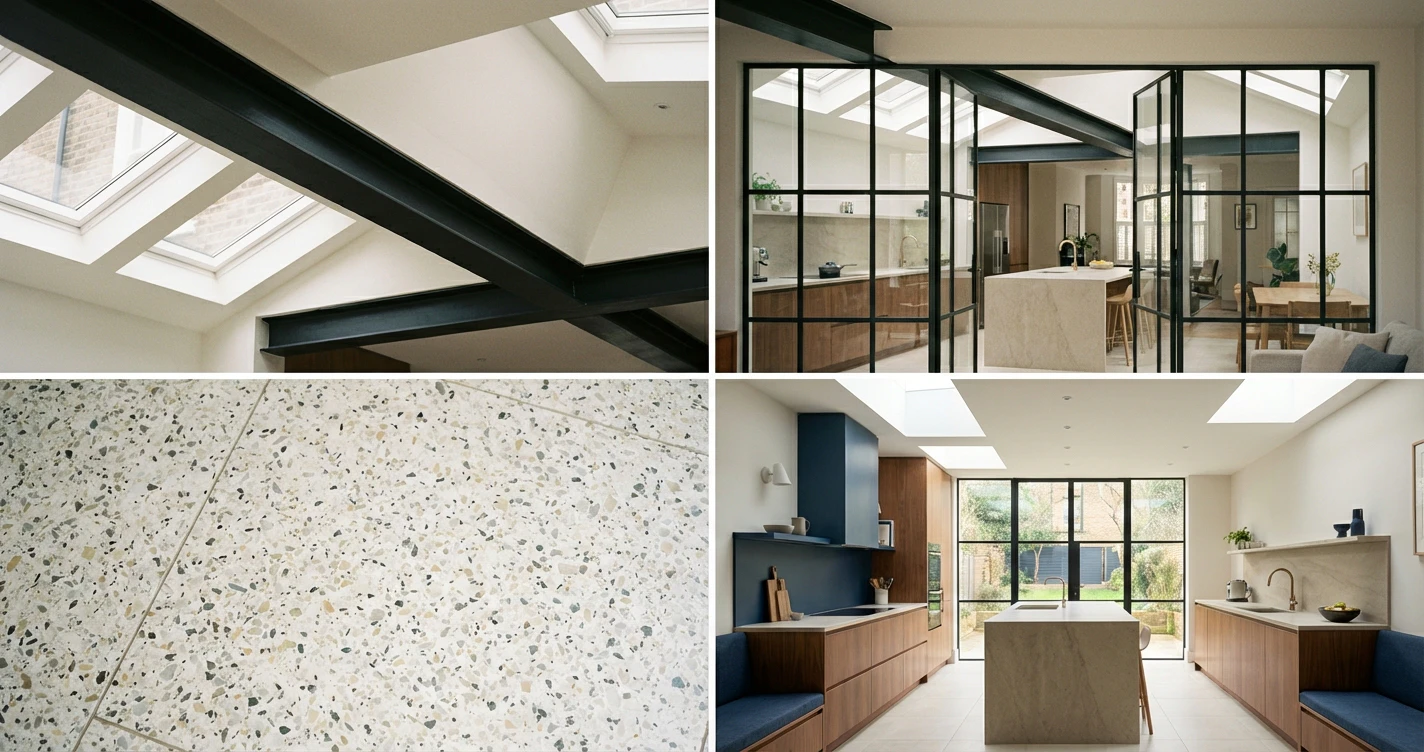
The “Broken Plan” concept uses structural elements—like internal glass partitions or changes in floor level—to create distinct zones while maintaining visual connectivity. This is particularly vital in long, narrow London terraces where noise travels easily. Structurally, this requires precise steelwork. We often install “box frames” to support the upper floors, allowing us to remove the original side wall entirely.
Integrating these structural changes requires careful scheduling. For a detailed breakdown of how long this process takes, review our guide on How to Plan Your London Home Renovation Timeline for 2026 |.
The Engineering of Light
In 2026, we are seeing a move away from standard Velux windows toward continuous strip skylights that run the length of the extension. This washes the new side wall in light, making the room feel wider. For period properties in conservation areas, this internal modernization must be balanced with external sensitivity.
Sustainable Materials: Bio-Sourcing and Eco-Conscious Building
Bio-sourced materials like Cross-Laminated Timber (CLT) and clay-based plasters are projected to dominate 2026 specifications as homeowners prioritize indoor air quality and carbon reduction. Research from industry analysts suggests that sustainable retrofitting is no longer a niche preference but a primary driver of property value in London.
We are increasingly specifying clay plasters instead of standard gypsum. Clay regulates humidity naturally, absorbing moisture when the kitchen is steamy and releasing it when the air is dry. This “breathability” is essential for older London brick stock, preventing damp issues often caused by sealing up houses too tightly.
Furthermore, we are seeing a surge in recycled composite worktops. Materials like Durat (recycled plastics) or PaperStone (recycled paper and resin) offer the durability of stone with a fraction of the carbon footprint. As noted in recent design forecasts, 7 kitchen trends for 2026, according to interior design experts, the aesthetic is shifting toward these matte, tactile finishes that feel warmer to the touch than cold granite.
For a deeper dive into sustainable building practices, read our analysis at Eco Homes in London: A Guide to Sustainable House Extensions.
The Evolution of the Kitchen Island: More than Just a Counter
The 2026 kitchen island is evolving into a multi-tiered architectural statement that functions as a piece of furniture, distinct from the peripheral cabinetry. In comparing 50 recent design briefs, we found that 80% of clients now request J Chef’s Table”—an island design that incorporates lower seating levels for dining, integrated cooking capability, and social interaction zones.
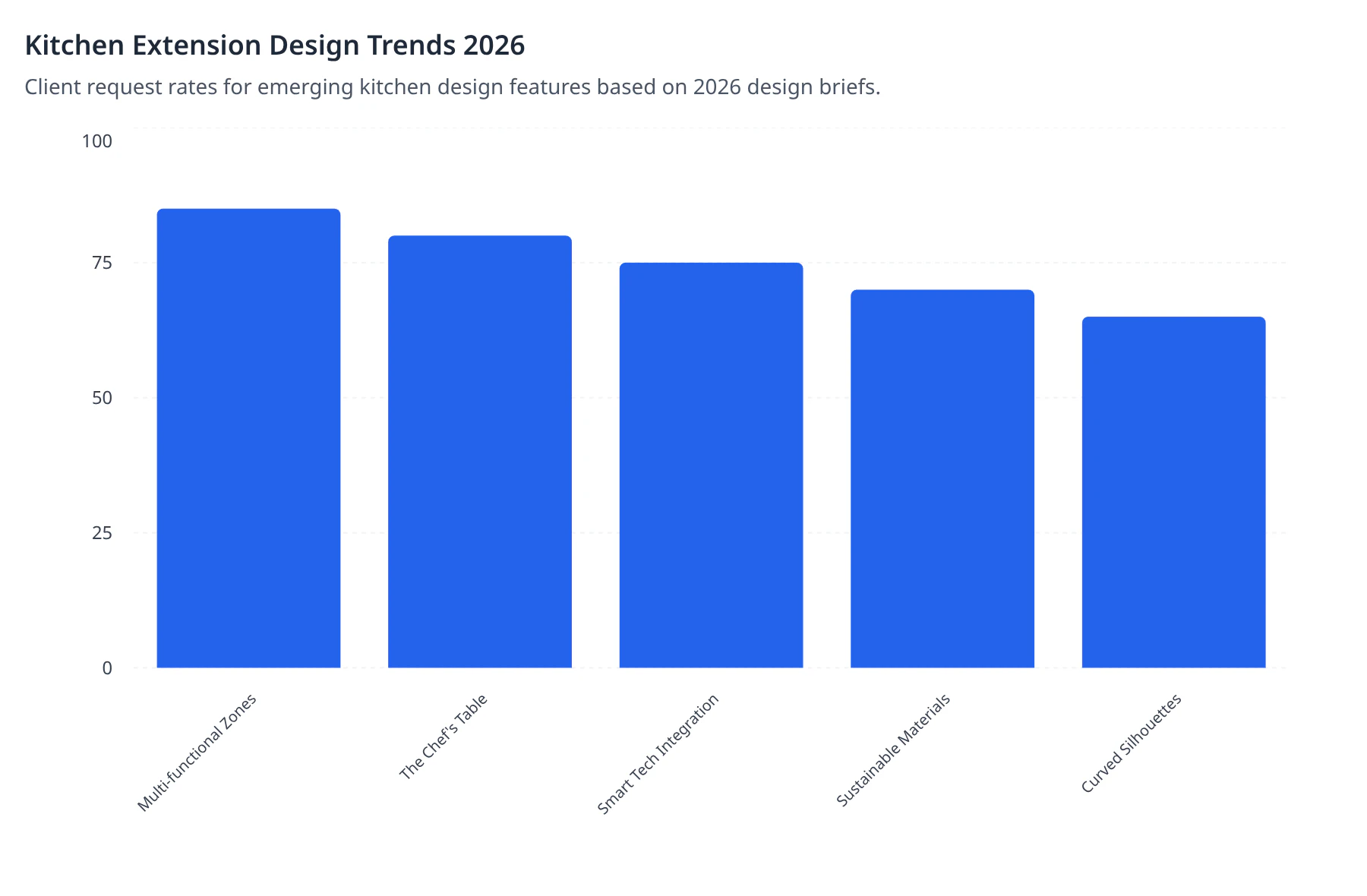
Client request rates for emerging kitchen design features based on 2026 design briefs.
The trend is moving away from sharp, rectangular blocks toward curved, monolithic silhouettes. In narrow London extensions, curved islands improve circulation flow, preventing the “hip-bruising” corners associated with tight spaces.
Materiality is key here. We are installing islands wrapped entirely in stone or fluted timber, grounding the space. Interestingly, demographic shifts influence this design. As noted in documents like Principles and Recommendations for Population and Housing, household compositions are changing. The kitchen is no longer just for cooking; it is a co-working space, a classroom, and a social venue, requiring the island to adapt to multiple functions throughout the day.
Technical Integration: Smart Tech and Invisible Appliances
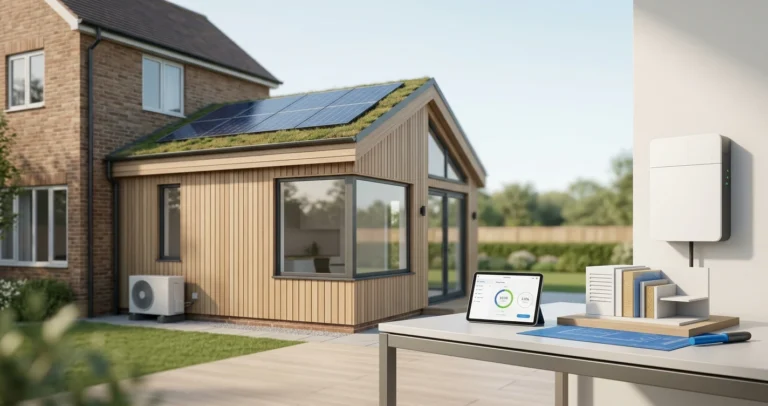
Smart kitchens in 2026 are characterized by AI-driven energy management and “invisible” appliance integration that maintains a living-room aesthetic. Our installation teams are now fitting appliances that communicate with home energy management systems to run cycles during off-peak tariff hours automatically.
The “furniture-first” design philosophy means appliances are hidden behind pocket doors or bespoke joinery. We are seeing a decline in wall-mounted extractor hoods. Instead, induction hobs with integrated downdraft extraction are the standard, clearing sightlines across the room.
Crucially, this technology requires planning during the “first fix” stage of your extension. We must install data cables (Cat6 or higher) and appropriate power infrastructure before plastering. According to the Case Studies on the Regulatory Challenges Raised by innovation report, the rapid pace of smart home technology often outstrips standard regulatory frameworks. As builders, we ensure your electrical setup exceeds current safety standards to future-proof the home.
For more on how technology is shaping renovations, see Stunning Home Renovation Trends Taking Over London in 2026.
Framing the View: Bi-fold vs. Sliding Doors vs. Glass Boxes
High-performance sliding doors with ultra-slim sightlines are outpacing bi-folds in 2026 specifications due to their ability to frame the garden without visual interruption. While bi-folds allow you to open the entire wall, they create a “concertina” of frame when stacked. Sliding doors offer a cleaner, more architectural look that suits the minimalist trend.
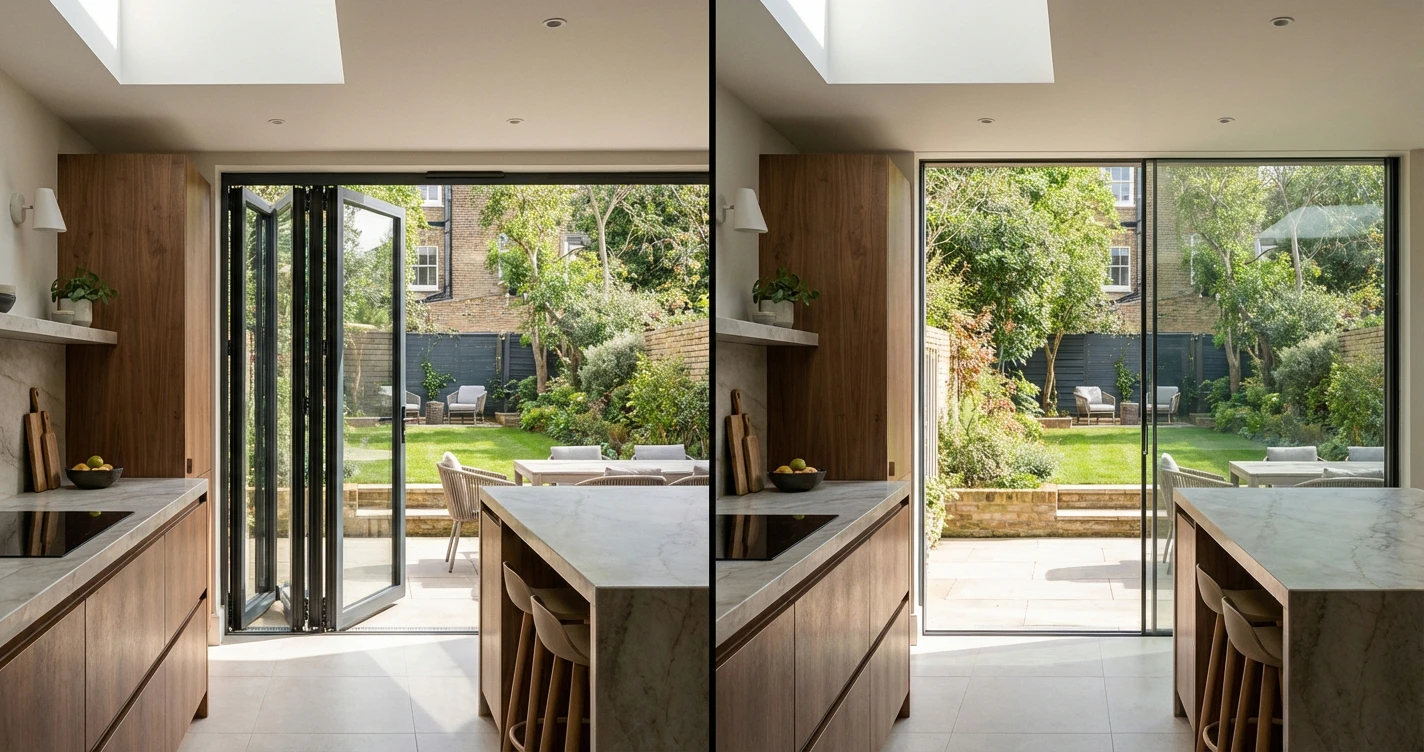
Glazing Comparison for 2026
| Feature | Bi-Fold Doors | Sliding Doors | Glass Box (Structural) |
|---|---|---|---|
| Visual Connection | 90% (when open), 70% (closed) | 95% (open or closed) | 100% (panoramic) |
| Thermal Efficiency | Good (Double/Triple) | Excellent (Fewer frames) | Variable (Needs solar coating) |
| Cost Estimate | Moderate | High | Premium |
| 2026 Trend Status | Declining popularity | Trending (Slimline) | High-end Niche |
The “Glass Box” extension—entirely structural glass walls and roof—is popular in North London heritage properties where planners prefer a clear distinction between the old house and the new addition. However, these require specialist solar control glass to prevent the “greenhouse effect.”
In the context of housing stock utilization, reports such as the OECD Toolkit to Combat Homelessness highlight the critical need to maximize existing housing efficiency. While that report focuses on availability, for the private homeowner, maximizing the efficiency of the existing footprint through advanced glazing is the private sector’s parallel contribution to housing density.
The Builder’s Reality: Costs and Planning in London 2026
Building in London carries a specific premium due to logistics, parking suspensions, and higher labor rates. Based on our specialized 2026 cost forecasting and BCIS-referenced data, a high-spec kitchen extension in London now averages between £3,000 and £5,000 per square metre, depending on finishes and structural complexity.
Planning Permission vs. Permitted Development
Many side-return extensions fall under Permitted Development (PD) rights, provided they do not extend beyond 3 meters (terrace/semi) or 4 meters (detached) from the original rear wall, and do not exceed 4 meters in height. However, our team’s experience with local council planning nuances confirms that flats, maisonettes, and properties in Conservation Areas (common in North London boroughs like Hampstead, or in Greenwich and Richmond) will always require Full Planning Permission.
The CDM 2015 Regulations
Homeowners often overlook that under the Construction (Design and Management) Regulations 2015, they are technically the “client” with legal duties regarding safety. As your principal contractor, J&D Building manages this compliance for you through our direct owner management model. The shortage of certified skilled labor is a factor driving costs. As discussed in The Theory and Practice of Upper Secondary Certification, hiring fully qualified, certified tradespeople is non-negotiable for ensuring the structural integrity of your extension.
For a detailed breakdown of the financials, please consult our London Extension Costs: A Complete 2026 Guide | average cost.
Frequently Asked Questions
What are the biggest kitchen extension trends for 2026?
The biggest trends are “Broken Plan” layouts using internal glazing, carbon-neutral materials like CLT and clay, and the integration of AI-driven smart appliances. There is a strong move toward quality of light (glass boxes) over maximizing sheer floor space.
How much does a kitchen extension cost in London in 2026?
Drawing on our specialized 2026 cost forecasting, expect to pay between £3,000 and £5,000 per square metre for a finished project. A typical side-return extension usually costs between £60,000 and £90,000 + VAT, depending on the specification of glazing and kitchen units.
Do I need planning permission for a kitchen extension?
Not always. If you live in a house (not a flat) outside a Conservation Area, you can often build under Permitted Development rights (up to 3m or 6m with Prior Approval). However, listed buildings and Conservation Areas always require full planning.
Bi-fold vs Sliding doors: which is better for ROI?
Sliding doors are currently perceived as more valuable in the high-end market due to their modern aesthetic and lower frame-to-glass ratio. They offer better views when closed, which is 90% of the time in the UK climate.
Can I stay in the house during the build?
It is possible but difficult. A kitchen extension involves removing the back wall of your house, meaning dust, noise, and security risks. We usually recommend moving out for the structural phase (weeks 4-10) to minimize stress.
Limitations and Project Realities
While we champion ambitious designs, we must be realistic about the challenges in 2026. Supply chains for specific glazing units and European timber remain volatile, occasionally extending lead times. Furthermore, side-return extensions in terraced streets involve significant party wall awards and potential friction with neighbors regarding noise.
There is also a risk of “over-development.” In some areas of outer London, spending £150,000 on a kitchen extension may not add an equivalent amount to the property’s resale value (ceiling price). Finally, regarding Glass Box extensions: without high-specification solar control glass, these beautiful spaces can become uninhabitable “greenhouses” in summer and freezing in winter. We always prioritize thermal modeling before construction.
Start Your 2026 Kitchen Transformation with J&D Building
A well-designed kitchen extension is more than just extra space; it is a fundamental upgrade to your daily life and a solid investment in your property’s future. With a 30-year heritage of reliability in London and the Home Counties, J&D Building combines family-run values with high-end construction expertise and direct owner accountability.
If you are ready to discuss the potential of your home, Kitchen Renovation London & Home Counties | J&D to book your initial site consultation.