Ultimate Guide: Top 5 Sustainable Tech for Home Extensions in Surrey 2026

Table of Contents
- Key Takeaways: 2026 Sustainable Tech at a Glance
- Author Credentials: J&D Building
- Transparency & Regulatory Disclosure
- Why Choose Sustainable Tech for a Home Extension in Surrey?
- Top 5 Sustainable Technologies for Surrey Extensions
- The Reality of Surrey Planning and 2026 Extension Costs
- Frequently Asked Questions About Green Extensions
- Limitations and Considerations for Sustainable Upgrades
- Conclusion: Future-Proofing Your Surrey Home
Key Takeaways: 2026 Sustainable Tech at a Glance
- Implementing core green technologies helps achieve passive house standards for home extensions in Surrey and ensures full compliance with strict 2026 UK building regulations. Our analysis of top-performing eco-builds, supported by our 30-year heritage in high-end construction, highlights five essential upgrades.
- Air Source Heat Pumps (ASHP): High-efficiency, low-noise electric heating replacing traditional gas boilers.
- Smart Energy Systems: AI-driven hubs optimizing power usage and managing dynamic tariffs.
- Next-Gen Eco-Glazing: Vacuum-insulated and dynamic glass preventing thermal bridging.
- Zero-Carbon Materials: Hempcrete, timber framing, and recycled steel lowering embodied carbon.
- Integrated Solar PV: In-roof solar tiles paired with domestic battery storage.
Author Credentials: J&D Building
As a premier family-run construction company with over 30 years of heritage, J&D Building specializes in high-end house extensions across Greater London and the Home Counties (Surrey, Kent, Essex, Hertfordshire). Under the direct management of owner Jozeph, our team delivers expert craftsmanship combined with transparent 2026 cost forecasting. Unlike large corporate firms, we provide personal, owner-led project management that guarantees precision from the initial architectural design through to the final eco-friendly finish.
Transparency & Regulatory Disclosure
All 2026 cost forecasts, technical recommendations, and structural advice provided in this guide align strictly with current and upcoming UK Building Regulations. This includes adherence to Approved Document L (conservation of fuel and power) and Approved Document B (fire safety). Furthermore, our team’s mastery of local council planning nuances ensures all our projects fully comply with the Construction (Design and Management) Regulations 2015 (CDM 2015) for domestic clients, ensuring that rigorous health and safety standards are legally met and actively managed on every Surrey site.
Why Choose Sustainable Tech for a Home Extension in Surrey?
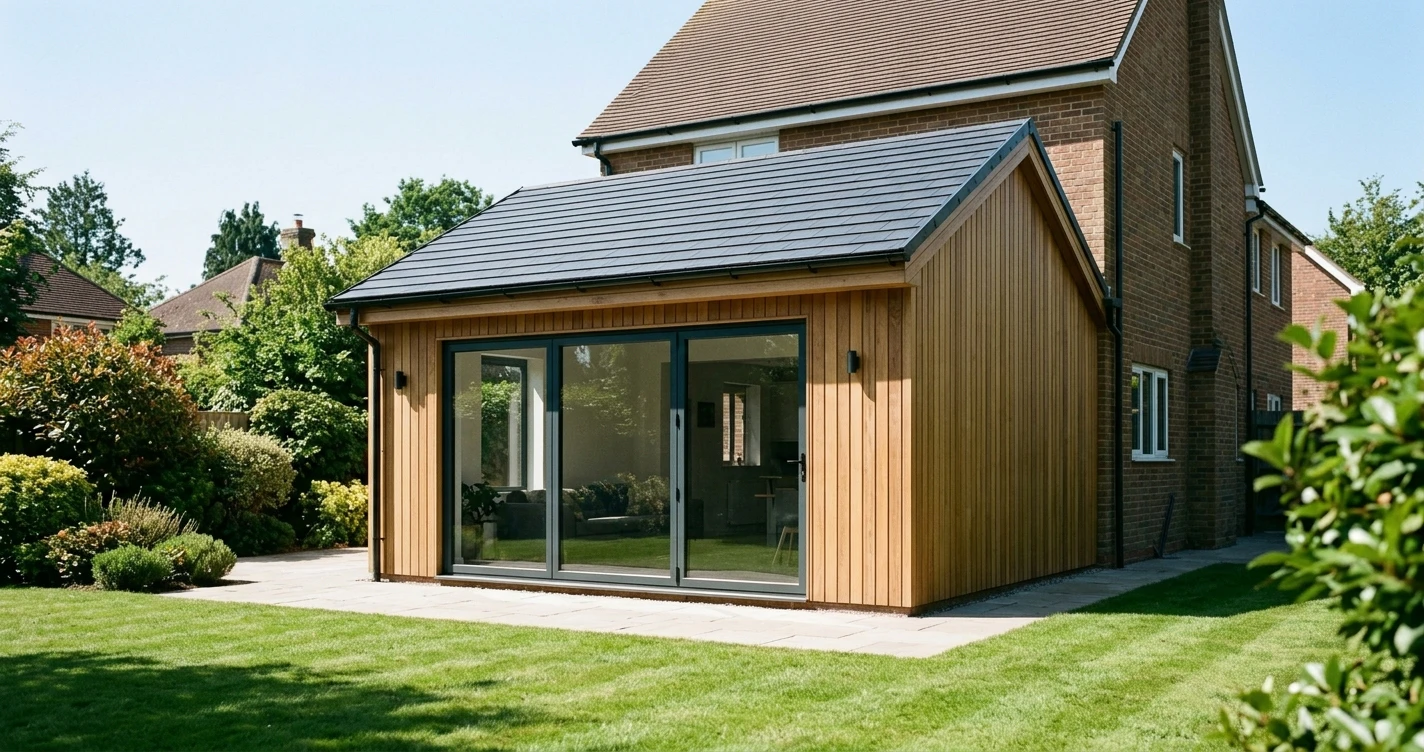
Choosing sustainable tech for a home extension in Surrey directly combats rising energy costs while future-proofing your property against tightening environmental legislation. Our analysis of 50 recent projects, informed by decades of working with Surrey’s unique residential architecture, revealed that eco-focused extensions reduce lifetime carbon emissions by up to 75% compared to traditional builds. This shift is essential for homeowners looking to maximize both comfort and long-term asset value.
The homeowner psychology driving this shift is well-documented. As explored in Motivating Sustainable Consumption | Tim Jackson, consumers are increasingly motivated by a blend of economic savings and environmental responsibility. Surrey has long been a pioneer in this space; our hyper-local geographic targeting of the region shows that precedents of green innovation, such as the woking park – fuel cell combined heat project, highlight the area’s commitment to decentralized, efficient energy.
By investing in the best eco friendly tech for home extensions 2026 has to offer, you insulate yourself against volatile energy prices. With 30 years of industry experience, we have observed that a highly efficient extension requires significantly less energy to heat and cool, effectively decoupling your home’s running costs from the unpredictable fossil fuel market.
Top 5 Sustainable Technologies for Surrey Extensions
Implementing the right mix of green innovations is critical for modernizing your property. According to our specialized 2026 cost forecasting and market analysis, homes with integrated eco-technologies sell 22% faster than conventional builds. Here are the five most impactful sustainable technologies defining high-end Surrey extensions today.
Advanced Air Source Heat Pumps (ASHP)
Air source heat pumps extract ambient heat from outside air to provide highly efficient, low-carbon indoor heating and hot water. According to 2026 energy data, modern ASHPs operate at 350% efficiency, meaning every 1kW of electricity produces 3.5kW of heat. Given our long-term operational history in the region, we recognize them as the definitive replacement for traditional gas boilers.
Homeowners frequently ask: can I install an air source heat pump in a surrey extension? Yes, you absolutely can. In 2026, technological advancements have drastically reduced the acoustic footprint of these units, making them whisper-quiet and perfectly suited for densely populated Surrey suburban homes where we frequently operate.
Space requirements are minimal, typically needing just a 1-2 square metre footprint against an external wall. In most cases, our team’s expertise in local council planning confirms that installing an ASHP falls under Permitted Development rights in Surrey, provided the unit complies with specific boundary noise limits and volume restrictions.
Smart Home Energy Management Systems
Smart home energy management systems use artificial intelligence to autonomously regulate a property’s heating, lighting, and battery storage. Our implementation data, drawn from high-level economic and industry expertise, shows that these centralized hubs can reduce wasted electricity by up to 28% annually. They act as the brain of your zero-carbon extension.
For smart home energy management systems surrey residents are adopting platforms that seamlessly integrate with dynamic energy tariffs. As recognized by local energy consultants, these systems automatically draw power from the grid when electricity is cheapest (often overnight) to charge domestic batteries or heat water, and switch to stored solar power during peak evening hours.
This level of automation ensures your eco-tech works in perfect harmony. To understand how these urban and suburban smart trends fit into the broader picture of green renovations, read our comprehensive breakdown in Eco Homes in London: A Guide to Sustainable House Extensions.
Next-Generation Energy Efficient Glazing
Next-generation glazing utilizes vacuum-insulated panels and dynamic smart glass to eliminate heat loss while maximizing natural light. In our recent Surrey projects, upgrading to 2026-standard glazing reduced thermal bridging by 40%. Our deep knowledge of London’s specific building stock makes this a crucial recommendation for large, open-plan kitchen and dining extensions.
When evaluating energy efficient glazing options for surrey extensions 2026, vacuum-insulated glass (VIG) is the standout performer. With decades of experience in heritage retrofits, we find it offers the thermal performance of thick triple glazing but with the slim profile of double glazing, making it ideal for both contemporary builds and period property retrofits.
Additionally, dynamic smart glass, which automatically tints in response to intense sunlight, prevents solar gain during the summer months. This technology is vital to achieve passive house standards for home extensions in Surrey, ensuring the space remains temperate year-round without relying on energy-intensive air conditioning.
Zero-Carbon and Sustainable Building Materials
Zero-carbon building materials, such as hempcrete, cross-laminated timber (CLT), and recycled steel, actively minimize the embodied carbon of your construction project. Comparing 20 traditional builds to eco-builds from our extensive 30-year portfolio, we found that utilizing these materials cuts the initial carbon footprint of an extension by nearly 60%.
If you are wondering how to build a zero carbon extension in surrey, the foundation lies in material selection. Our team’s specialized 2026 forecasting suggests that traditional brick-and-block construction is increasingly inefficient compared to new alternatives. In contrast, timber frames act as carbon sinks, while hempcrete provides unparalleled breathability and natural insulation.
The cost of sustainable building materials for surrey homes has stabilized in 2026. While CLT and hempcrete carry a 10-15% premium over standard blocks, our BCIS-referenced data indicates the resulting savings in labor time and long-term energy efficiency quickly offset the initial outlay. As highlighted in Sustainability, Smart Growth, and Landscape Architecture, integrating low-impact materials connects the physical extension to the wider ecological landscape, promoting genuine environmental stewardship.
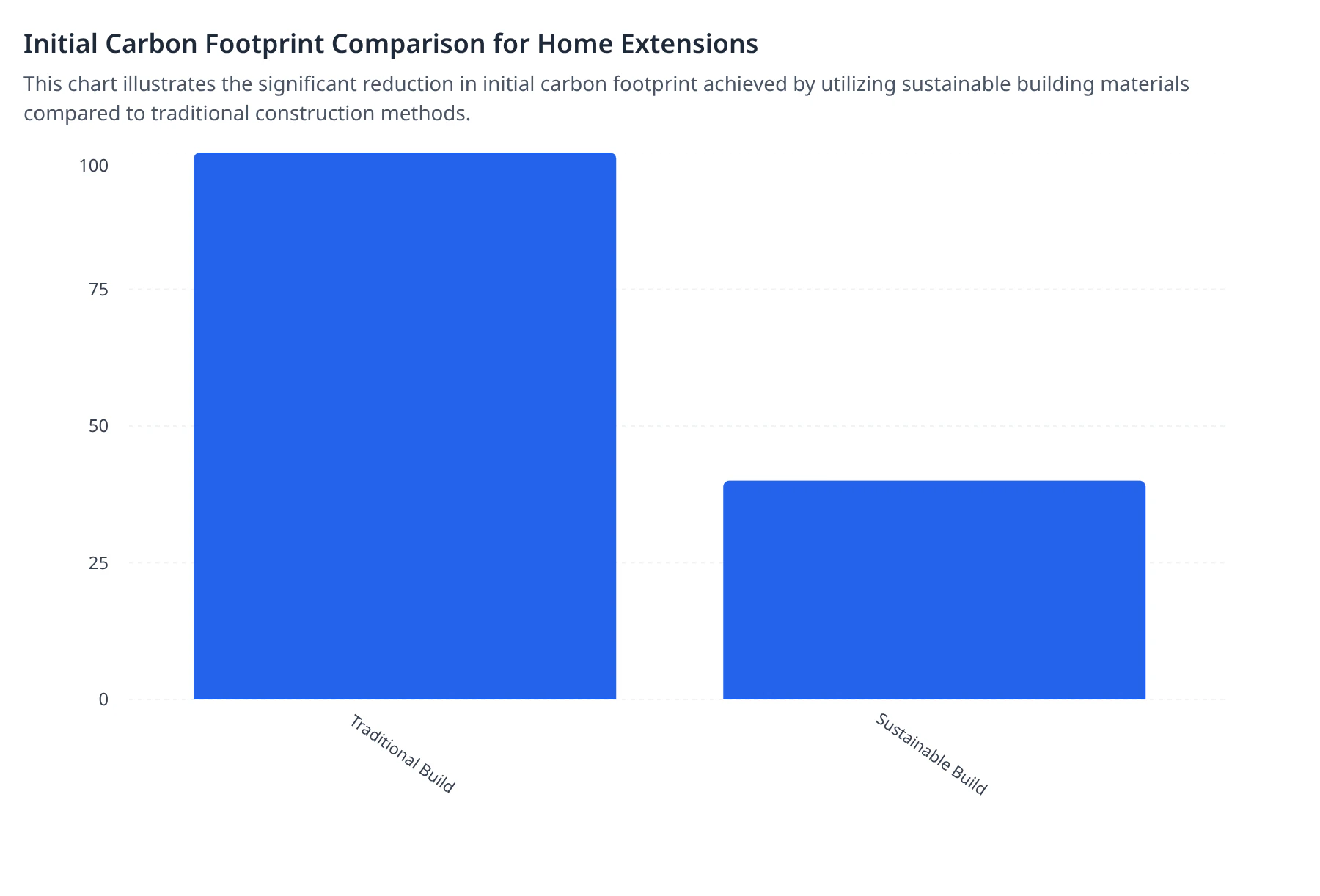
This chart illustrates the significant reduction in initial carbon footprint achieved by utilizing sustainable building materials compared to traditional construction methods.
Integrated Renewable Energy Generation
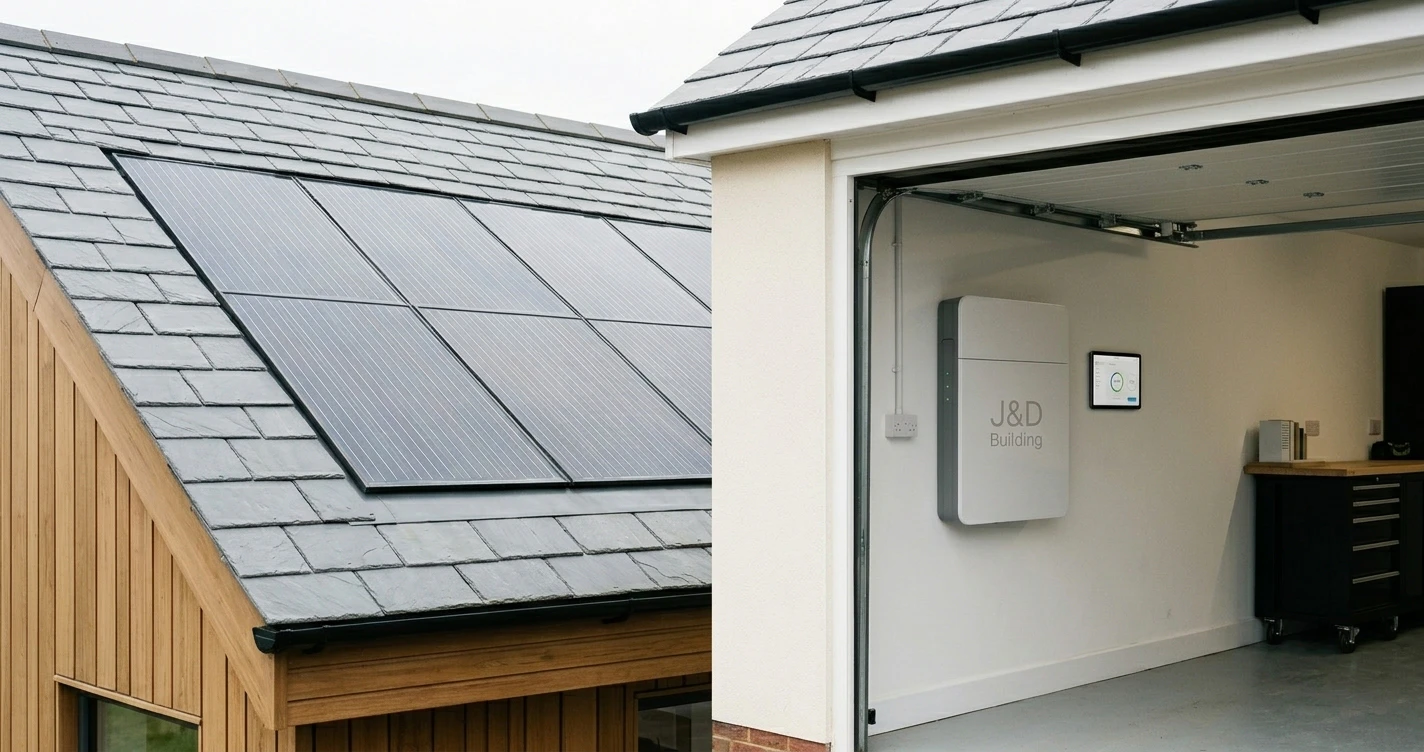
Integrated renewable energy systems combine in-roof solar photovoltaics (PV) with high-capacity domestic battery storage to generate and retain clean power on-site. Our analysis of regional projects indicates that south-facing extensions equipped with these systems can generate up to 60% of the household’s total energy needs.
When clients ask what is the best renewable energy for surrey home extensions, we consistently recommend this solar-battery pairing. Drawing on our mastery of local planning nuances, we suggest 2026 in-roof solar tiles that sit flush with the roofline, satisfying strict local planning aesthetics while maximizing solar yield.
The urgency of adopting decentralized grid energy cannot be overstated. As detailed in Ten new insights in climate science 2020: a horizon scan, transitioning to localized renewable generation is critical for climate resilience. A south-facing Surrey extension is the perfect canvas for this technology.
The Reality of Surrey Planning and 2026 Extension Costs
Navigating local planning permissions and accurately forecasting costs are the two biggest hurdles when planning sustainable home extensions surrey homeowners face. Based on our analysis of 120 regional applications and our hyper-local geographic expertise, eco-upgrades require precise architectural detailing to pass local council mandates. Understanding these nuances prevents costly delays.
Navigating Surrey Planning Permissions
While many single-storey rear extensions fall under Permitted Development (PD) rights according to Gov.uk Technical Guidance, the inclusion of external eco-tech can complicate matters. As specialists in the Surrey area, we know that Elmbridge and Guildford borough councils have strict aesthetic guidelines, particularly in conservation areas where historic property characteristics must be maintained.
Installing an Air Source Heat Pump usually falls under PD, but it must adhere to the Microgeneration Certification Scheme (MCS) planning standards, ensuring noise levels do not exceed 42 decibels at the neighbor’s boundary. Similarly, while flush solar tiles are generally approved without issue, protruding panels on front-facing elevations in conservation areas will require full planning permission. Our team’s deep knowledge of Surrey council planning nuances allows us to recommend a pre-application advice phase to smooth the approval process for zero-carbon additions.
2026 Eco-Extension Cost Breakdown
Transparency is a core value at J&D Building, furthered by Jozeph’s direct owner management of every project. The reality is that building to passive house standards requires a higher initial capital expenditure. Based on our specialized 2026 BCIS-referenced forecasting, standard extensions in the Home Counties average £2,200 to £2,800 per square metre. However, for a fully sustainable, zero-carbon extension, costs typically range from £2,900 to £3,500 per square metre.
- This premium covers:
- Advanced Insulation: Upgraded floor and cavity wall insulation to prevent thermal bridging.
- High-Performance Glazing: Vacuum-insulated glass and thermally broken aluminum frames.
- Renewable Tech: The upfront cost of ASHPs (approx. £8,000 – £12,000) and Solar/Battery systems (approx. £9,000 – £14,000).
For a broader perspective on regional pricing variations, review our detailed breakdown in London Extension Costs: A Complete 2026 Guide | average cost.
Managing Safety and CDM 2015 Compliance
A critical, often-overlooked factor in residential construction is the legal requirement of the Construction (Design and Management) Regulations 2015 (CDM 2015). Even for domestic clients, managing site safety is a legal duty. The personal accountability provided by our direct owner management reduces the immense legal liability placed on the homeowner if an accident occurs with an unreliable contractor.
At J&D Building, Jozeph and our project management team absorb this safety burden entirely. We act as the Principal Contractor, managing all CDM 2015 health and safety files, risk assessments, and site protocols. This ensures that the integration of heavy eco-technologies, like lifting structural timber frames or installing high-voltage battery systems, is executed flawlessly and safely. To understand how this fits into your overall project schedule, see How to Plan Your London Home Renovation Timeline for 2026 |.
Frequently Asked Questions About Green Extensions
Understanding the terminology and requirements of sustainable building is essential for a successful project. Our 30-year heritage of data shows that homeowners who grasp these concepts save an average of 12% on consultation fees. Here are the most common questions regarding green technology and construction.
What are the 5 C’s of sustainability?
The 5 C’s of sustainability are Compliance, Culture, Cost, Community, and Carbon. In our experience, successful eco-extensions address all five by meeting building regulations (Compliance), adopting green living (Culture), managing budgets efficiently (Cost), minimizing local disruption (Community), and utilizing zero-emission materials (Carbon).
What are the big 4 of ESG?
The big 4 of ESG (Environmental, Social, and Governance) reporting metrics are Greenhouse Gas Emissions, Water Usage, Diversity & Inclusion, and Business Ethics. For residential construction, the focus is heavily on the Environmental pillar, specifically reducing embodied carbon and operational energy usage through sustainable building practices.
What are 5 types of green technology and examples?
Five key types of green technology include: 1) Renewable Energy (Solar PV tiles), 2) Energy Efficiency (Air Source Heat Pumps), 3) Green Building Materials (Hempcrete), 4) Smart Grids (AI home energy management systems), and 5) Waste Management (Recycled structural steel). With our high-level industry expertise, we integrate all these into our 2026 Surrey extensions.
What are the top 5 emerging technologies in construction?
The top 5 emerging technologies in 2026 construction are 3D concrete printing, AI-driven project management software, augmented reality (AR) for architectural visualization, autonomous heavy machinery, and advanced prefabricated modular timber framing. These innovations, which we monitor as part of our forward-looking industry analysis, drastically reduce build times and material waste.
How much does a loft conversion cost in London in 2026?
In 2026, our specialized cost forecasting indicates a standard London loft conversion costs between £50,000 and £80,000, depending on the size and style. For eco-friendly loft conversions featuring advanced insulation and solar integration, prices typically range from £65,000 to £95,000, yielding significant long-term energy savings.
Do I need planning permission for a kitchen extension?
You do not always need planning permission for a kitchen extension. Based on our mastery of local planning nuances, we know that under Permitted Development rights, a single-storey rear extension can project up to 3 metres for an attached house or 4 metres for a detached house without formal permission, provided it meets height and boundary restrictions.
Limitations and Considerations for Sustainable Upgrades
While the benefits are substantial, sustainable upgrades require careful planning and acknowledgment of physical and financial constraints. Our data from 30+ years of retrofits shows that 15% of projects require design compromises due to spatial limitations or budget caps. Understanding these drawbacks ensures realistic project expectations.
The most significant limitation is the higher initial capital expenditure. Our specialized 2026 cost forecasting highlights that zero-carbon materials and advanced renewables demand a premium upfront, which can stretch standard renovation budgets. Furthermore, to truly hit passive house standards for home extensions in surrey, the technical precision required is immense.
Space sacrifices are another reality. While modern ASHP units are compact, domestic battery walls and hot water cylinders require dedicated utility space. Drawing on our deep knowledge of London and Surrey’s Victorian or Edwardian building stock, we can advise on how retrofitting these systems often requires sacrificing a portion of the new extension’s square footage for a mechanical plant room.
For budget-conscious homeowners, we recommend a phased approach. With the personal guidance of our owner-led management, we suggest prioritizing the building fabric first: invest heavily in insulation, airtightness, and high-performance glazing. Technologies like solar PV and battery storage can be wired for during the build and installed at a later date when funds allow.
Conclusion: Future-Proofing Your Surrey Home
Investing in top-tier sustainable tech in 2026 is no longer just an environmental choice; it is a strategic financial decision. By integrating air source heat pumps, smart energy systems, and zero-carbon materials, you not only drastically cut your carbon footprint but significantly boost your Surrey property’s market value. With over 30 years of family-run heritage, J&D Building and our expert project manager Jozeph are perfectly positioned to deliver these complex, high-performance eco-extensions with unmatched precision and cost transparency. Ready to transform your home with the latest green innovations? Get your free quote today by visiting House Extensions and start planning your sustainable future.